

Abstract :-
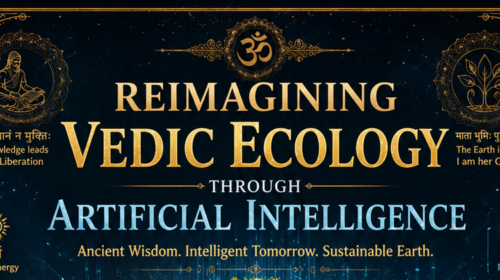
Environmental degradation and climate change have forced societies across the world to rethink their relationship with nature. While scientific solutions remain essential, cultural narratives and ethical frameworks also play a crucial role in shaping ecological consciousness. Indian mythological literature including the Vedas, Upanishads, Puranas, and epics—contains profound ecological wisdom rooted in the philosophy of harmony between humans and nature The Vedic concept of Panchamahabhuta (the five cosmic elements—earth, water, fire, air, and space) presents the environment as an intrinsic component of existence rather than an external entity. Within this framework, disturbances in the macrocosmic elements inevitably affect the microcosmic life of human beings. By integrating the Vedic concepts of Prakriti, Dharma, and Rta with Generative AI, Virtual Reality, and Predictive Analytics, we can create immersive, culturally resonant stories. These “Sustainable Narratives” transform the environment from a resource to be managed into a sacred entity to be protected, fostering a deep-seated ecological consciousness fit for the digital age.
The paper argues that combining mythological ecological wisdom with AI-based narrative systems can strengthen environmental education, promote sustainable values, and create culturally grounded climate communication strategies.
Introduction :-
The contemporary world faces unprecedented environmental challenges including global warming, deforestation, water scarcity, and biodiversity loss. Scientific and technological solutions alone may not be sufficient to address these problems; cultural narratives and ethical frameworks also play a crucial role in shaping environmental attitudes. Human civilizations have always used stories to understand their relationship with nature. Long before environmental science emerged as a discipline, traditional cultures expressed ecological awareness through myths, legends, and sacred narratives. Indian literature is particularly rich in this regard. Rivers are worshipped as goddesses, mountains are sacred abodes of deities, and animals often appear as divine companions or incarnations.
Simultaneously, Artificial Intelligence is transforming the way narratives are created, analyzed, and disseminated. AI-driven storytelling tools, natural language processing, and generative models can reinterpret traditional mythological narratives to communicate environmental values to modern audiences. AI systems can process vast amounts of cultural texts, generate narratives, and create immersive digital experiences.
This paper explores how Indian mythological traditions and AI technologies can be combined to generate sustainable environmental narratives, making ancient ecological wisdom relevant in the digital age.
Ecological Consciousness in Vedic Thought :-
Indian mythology does not view the environment as a resource to be exploited, but as a manifestation of the Divine. The philosophical concept of ṛta (cosmic order) in the Vedas reflects the idea that harmony between humans and nature is essential for maintaining universal balance. The concept of “Vasudhaiva Kutumbakam” (The world is one family) extends kinship to non-human entities.
- The Prithvi Sukta of the Atharva Veda serves as perhaps the oldest environmental manifesto. It emphasizes a reciprocal relationship between Earth and humanity:
यस्यां वृक्षा वनस्पतयस्तिष्ठन्ति ध्रुवा उता।
सा नो भूमिः सर्वतः पृच्छतु नः श्येनायमाना॥ —Atharva Veda 12.1.27
“On whom the trees and plants stand firm and unshakable; may that Earth, which supports all, grant us wealth and strength.”
- One famous Vedic verse expresses this sense of unity with the Earth:
“माता भूमिः पुत्रोऽहं पृथिव्याः” Atharva Veda 12.1.12
The Earth is my mother, and I am her son.
This verse reflects a profound ecological ethic. The Earth is not merely land or territory but a nurturing mother.
- Similarly, another Vedic hymn emphasizes environmental harmony:
“ॐ द्यौः शान्तिः अन्तरिक्षं शान्तिः पृथिवी शान्तिः
आपः शान्तिः ओषधयः शान्तिः” Yajurveda (36.17)
“Peace be in the heavens, peace in the atmosphere, peace on Earth; peace in waters, peace in plants.”
- The Isha Upanishad emphasizes restraint and respect for natural resources:
“ईशावास्यमिदं सर्वं यत्किञ्च जगत्यां जगत्
तेन त्यक्तेन भुञ्जीथा मा गृधः कस्यस्विद्धनम्।”
“All this whatever exists in this universe belongs to the Divine. Enjoy it with renunciation; do not covet what belongs to others.”
This teaching encourages sustainable consumption and discourages greed.
- One famous ecological verse emphasizes the value of trees:
दशकूपसमा वापी दशवापिसमो ह्रदः ।
दशह्रदसमः पुत्रो दशपुत्रसमो द्रुमः ॥ (Matsya Purana)
A pond equals ten wells a reservoir equals ten ponds
a son equals ten reservoirs but a tree equals ten sons.
This verse highlights the ecological and social importance of tree conservation.
Environmental Symbolism in Ancient Indian Knowledge Traditions :-
Environmental scholars increasingly recognize that scientific data alone is often insufficient to inspire behavioral change. Narratives especially those rooted in cultural identity have the power to evoke emotional and moral engagement.
- Sacred Rivers and Water Ethics
Rivers are often revered as life-giving entities rather than mere physical resources. The rivers like Ganga, Yamuna and Saraswati are frequently personified as a divine presence whose descent to Earth is described in texts such as the Ramayana, Mahabharata and various Puranas. This narrative tradition emphasizes the sacredness of water and its essential role in sustaining life.
In Vedic literature, Parjanya is revered as the deity governing rain, thunder, and atmospheric fertility. The hymns of the Rig Veda portray Parjanya as a life-giving force whose rains nourish the earth, stimulate vegetation, and ensure agricultural prosperity. Thus, Parjanya symbolizes the fertility and regeneration of the earth through rainfall.
By portraying rivers as sacred and worthy of reverence, ancient Indian traditions reflect a cultural understanding that water systems are fundamental to ecological balance, agriculture, and human survival.
- Forests Landscapes as Spaces of Ecological Harmony
Ancient Indian literature frequently portrays forests not as hostile wilderness but as living ecological environments where human life, spirituality, and biodiversity coexist.
Forest hermitages (ashrams) described in texts such as the Ramayana function as centers of learning and contemplation located within nature itself. The forest (Aranya) thus becomes a symbol of ecological balance, where sages, animals, and plant life share the same environment in harmony.
Another important narrative that reflects environmental consciousness is the story of Krishna lifting Govardhan Hill, described in the Bhagavata Purana. In this episode, Krishna encourages the people of Vrindavan to worship the hill, forests, and cattle that sustain their livelihoods instead of performing rituals for Indra. When Indra sends destructive storms in anger, Krishna lifts the hill to protect the community and its animals.
The narrative symbolically highlights the importance of respecting natural landscapes and recognizing the ecological systems that support human life.
- Animals as divine companions
Ancient Indian traditions frequently associate animals with divine figures, symbolizing the interconnectedness between human life and the broader natural world. For instance,
- Shiva with Nandi (bull)
- Vishnu with Garuda (eagle)
- Durga with a lion
- Ganesha with a mouse
A deeper expression of this idea appears in the Dashavatara, the ten incarnations of Lord Vishnu, where early incarnations such as Matsya(fish), Kurma(tortoise), and Varaha(boar) appear in animal forms. These narratives symbolically emphasize that all forms of life are interconnected and essential for maintaining balance in nature.
Narrative Power and Environmental Awareness :-
Stories are powerful tools for shaping human values. Environmental communication scholars argue that narratives often influence attitudes more effectively than scientific data alone.
Indian narratives carry symbolic meanings that help communities understand ecological relationships. For instance, sacred groves associated with local deities have historically contributed to biodiversity conservation in India. Because these areas were considered sacred, communities protected them from deforestation. These narratives implicitly promote values such as humility before nature, respect for biodiversity, and recognition of ecological interdependence.
However, in contemporary digital culture, traditional stories are sometimes disconnected from everyday environmental concerns. Reinterpreting these narratives through modern technological tools may help revive their relevance.
Reimagining Mythological Narratives Through AI :-
AI technologies such as generative models, natural language processing, and interactive storytelling can reinterpret mythological narratives in multiple ways. Emerging AI technologies provide new possibilities for reinterpreting traditional narratives, enabling ancient ecological ideas to be communicated through contemporary digital storytelling formats. For example, the story of the descent of the river Ganga—from the heavens to Earth through the penance of King Bhagiratha—can be retold using AI-generated digital storytelling platforms to emphasize modern concerns about river pollution and water conservation.
Similarly, AI systems can analyze mythological texts to identify recurring ecological motifs such as sacred forests, divine animals, and cosmic balance. For instance, AI-supported educational platforms could allow learners to explore the forest landscapes described in the Ramayana while simultaneously learning about biodiversity conservation, climate change, and sustainable ecosystems.
Through such reinterpretations, AI can transform mythology into a living narrative that evolves alongside contemporary environmental concerns.
Implications for Sustainability Communication :-
AI can reinterpret mythological themes to produce narratives that highlight sustainability. This approach offers several significant benefits, including:
- Environmental Education: AI-based storytelling platforms can help students engage emotionally with sustainability issues.
- Cultural Preservation: Digitizing and analyzing mythological texts help protect intangible cultural heritage.
- Public Engagement: Interactive narratives can connect environmental responsibility with cultural identity.
- Interdisciplinary Innovation: The intersection of mythology, environmental studies, and artificial intelligence opens new possibilities for research and education.
- AI Visualization: AI-based visual tools can recreate mythological ecosystems such as sacred forests and ancient rivers, helping audiences visualize ecological harmony.
By combining ancient cultural wisdom with modern technology, societies may discover new ways to inspire ecological responsibility.
Methodology :-
This research adopts a qualitative interdisciplinary approach, combining:
- Textual analysis of Vedic and Puranic literature
- Narrative analysis of mythological ecological themes
- Technology review of AI storytelling systems
The methodology integrates comparative mythology, digital humanities, and sustainability studies to explore the potential synergy between mythological narratives and AI technologies.
Conclusion :-
The exploration of Indian mythology alongside contemporary artificial intelligence reveals a compelling framework for reimagining environmental narratives in the age of ecological crisis. Ancient Indian scriptures and mythological traditions articulate a deeply ecological worldview in which nature is not merely a resource but a sacred and living entity intertwined with human existence. The ethical foundation of this approach is deeply rooted in classical Indian philosophical ideals. The principle of “वसुधैव कुटुम्बकम्”, articulated in ancient Indian texts, proclaims that the entire world is one family, emphasizing universal interconnectedness between humans, nature, and all living beings. Similarly, the universal benediction “सर्वे भवन्तु सुखिनः, सर्वे सन्तु निरामयाः” envisions the well-being and harmony of all existence.
The goal isn’t just to talk about the past, but to use the smartest tools of the future (AI) to protect our oldest home (Earth). When we combine the soul of Indian mythology with the brain of AI, we get a story that can actually change the world.
References :-
- Atharva Veda. (1950). Hymns of the Atharva-Veda (M. Müller, Ed.; M. Bloomfield, Trans.). Sacred Books of the East, Vol. 42. Clarendon Press. (Original work published c. 1000 BCE).
- Isha Upanishad. (1996). In E. Easwaran (Trans.), The Upanishads. Nilgiri Press.
- Matsya Purana. (2007). (N. S. Singh, Ed.). Nag Publishers.
- Bhagavata Purana. (1987). (A.C. Bhaktivedanta Swami Prabhupada, Trans.). Bhaktivedanta Book Trust.
- Yajur Veda. (1990). The Texts of the White Yajurveda (R. T. H. Griffith, Trans.). Munshiram Manoharlal Publishers.
- Chapple, C. K., & Tucker, M. E. (Eds.). (2000). Hinduism and Ecology: The Intersection of Earth, Sky, and Water. Harvard University Press.
- Dwivedi, O. P. (2001). Classical India’s Environmental Ethics. In J. B. Callicott & R. T. Ames (Eds.), Nature in Asian Traditions of Thought: Essays in Environmental Philosophy. State University of New York Press.
- Gold, A. G., & Gujar, B. R. (2002). In the Time of Trees and Sorrows: Nature, Power, and Memory in Rajasthan. Duke University Press.
- Prime, R. (2002). Vedic Ecology: Practical Wisdom for Surviving the 21st Century. Mandala Publishing.
- Nijholt,A.(Ed.). (2019). Making Believe: Interdisciplinary Perspectives on Green AI and Narrative Storytelling. Springer Nature.
- Riedl, M. O. (2016). Computational Narrative Intelligence: A Human-Centered Goal for Artificial Intelligence. CHI’16 Workshop on Human-Centered Machine Learning.
- Mani, K. P. (2021). Digital Humanities and Indian Mythology: New Directions in Narrative Analysis. Routledge India

Research Scholar
Dept. of Hindu Studies
Shri Lal Bahadur Shastri National Sanskrit University- New Delhi
Contact- 7906217473
sonambhimwal07@gmail.com